Local SEO for Multi-Location Dental Groups: What Changes at 5+ Offices
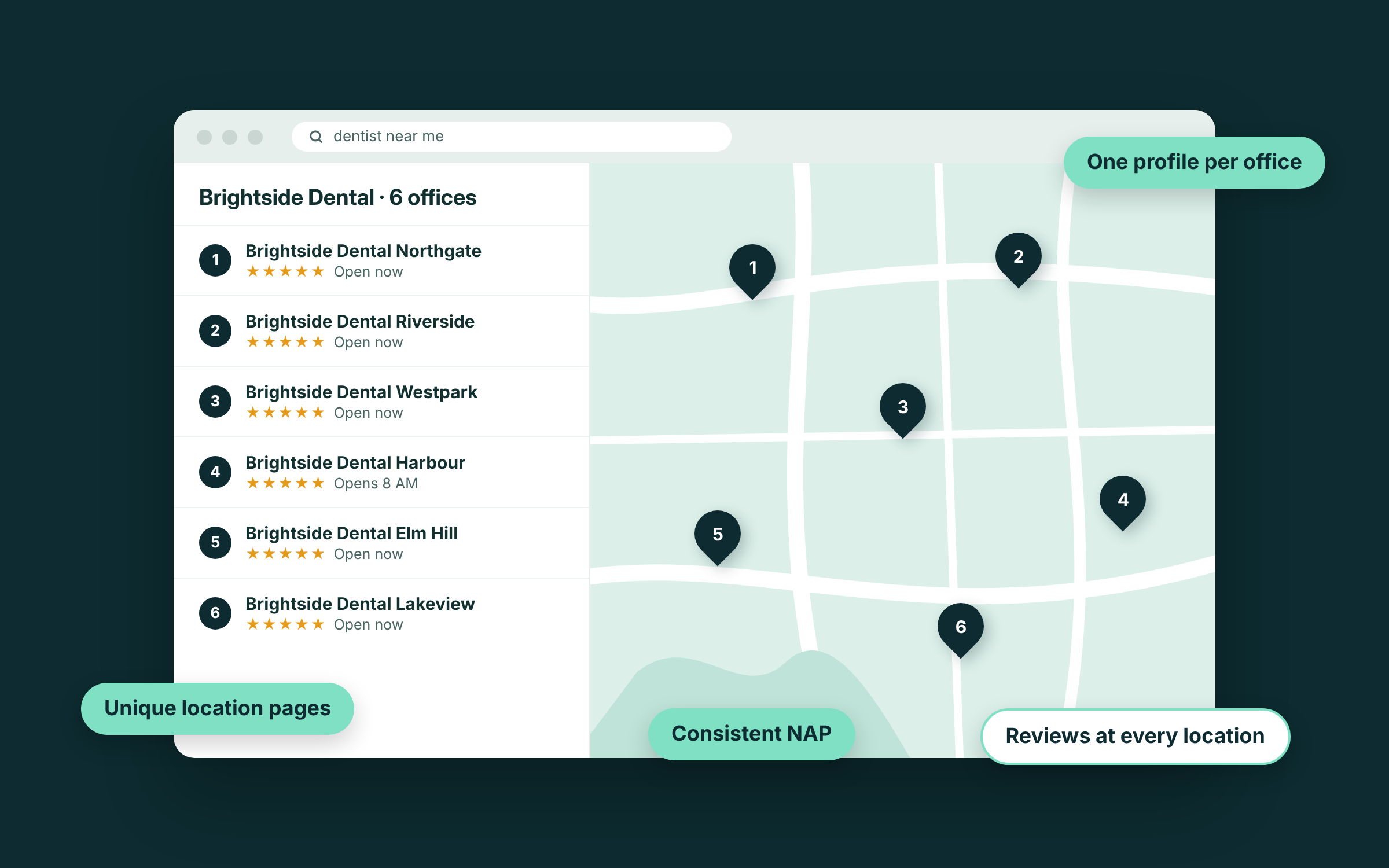
Local SEO for one dental office is mostly a checklist. Local SEO for five or more is an operations problem. The tactics barely change, but keeping them consistent across every location, through acquisitions, rebrands, staff turnover and approval chains, is where most groups start losing rankings.
I've spent two years embedded with a dental group of more than 25 locations, maintaining their websites and running local SEO. This is what changes once a group passes about five offices, and how to keep it under control.
Google Business Profile access. At one office, the owner has the login. At ten, access is spread across former office managers, old agencies, personal Gmail accounts and nobody at all. Before any optimization, someone has to own every profile through a single organization account, with clear manager roles.
NAP consistency. Every acquisition, rebrand, move or new phone line creates a mismatch between your website, Google, Yelp, Facebook and dozens of directories. A practice that changed its name can keep its old name on directories for years. That inconsistency makes Google less confident about which listing is correct, and map rankings suffer.
Duplicate and thin content. The fastest way to launch ten location pages is to copy one and swap the city name. Google sees through that, and those pages rarely rank.
Tracking. Rankings are local, so one keyword check from head office means little. You need rank tracking per location, ideally with geo-grid scans that show visibility across each office's actual service area.
Approvals and speed. In a group, a simple change can need sign-off from a doctor, an office manager and a marketing director. Fixes that take a day at a solo practice can take a month. That delay is where many groups quietly lose ground.
Each location page needs information that's only true for that office. That's what makes it useful to patients and gives Google a reason to rank it.
Some things that work well:
The test is simple: if you could swap the city name and the page would still be accurate, it's too generic. Make every location page unique and real.
They treat the group as one big website. Each office competes in its own local market against its own competitors. A strategy that works in a suburb with two competing practices won't work downtown with twenty. Priorities should be set location by location.
They report averages. Group-wide totals can look healthy while three offices are invisible in their own neighbourhoods. Reporting should show each location separately so weak spots aren't hidden.
They ignore how the group actually runs. Agencies plan as if changes go live the same week. In reality, acquisitions, brand transitions, staff changes and approval chains shape what can get done. A plan that ignores those constraints stalls.
They don't connect SEO to the front desk. More calls don't help if they go unanswered or new-patient forms sit unread for two days. In a group, speed to lead varies a lot between offices, and it's worth checking before spending more on visibility.
If you manage marketing for a multi-location dental group and want to know which offices are underperforming locally, Secondpractice offers a free multi-location visibility audit.